
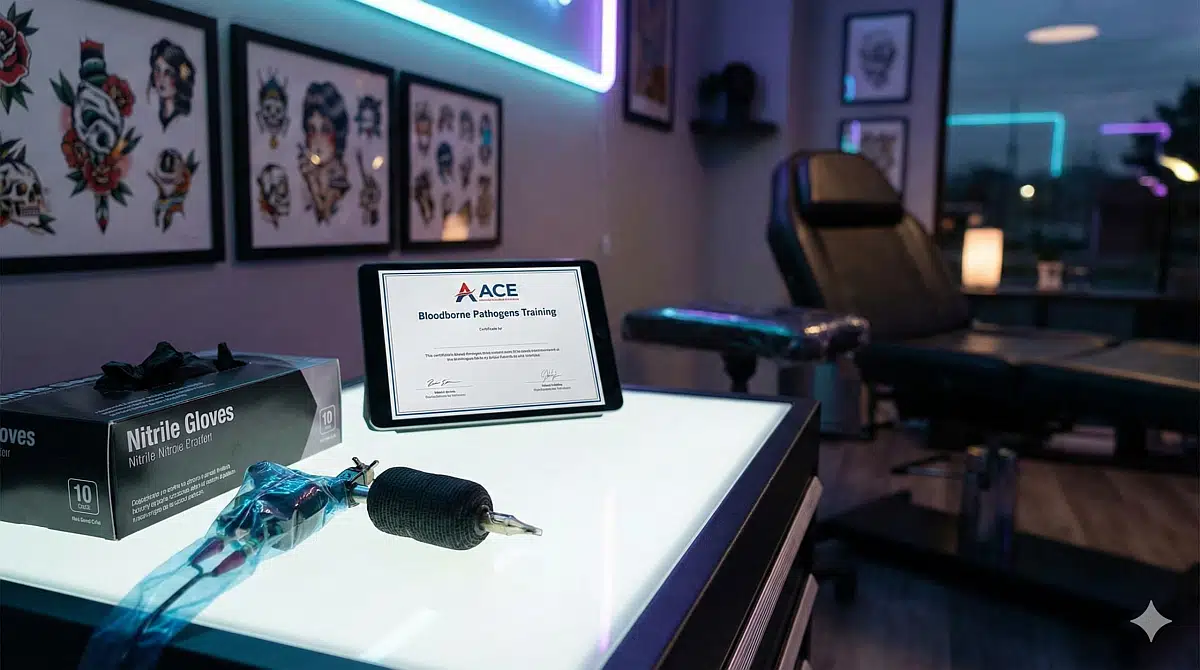
Cross contamination setup is vital for OSHA compliance. Learn Colorado aseptic technique requirements for secondary containers with ACE BBP Training.
Cross contamination setup is a critical component of workplace safety and OSHA medical compliance. In high-risk environments like Colorado tattoo and body art studios, the implementation of a rigorous cross contamination setup ensures that both the practitioner and the client are protected from life-altering bloodborne pathogens (BBPs). ACE Bloodborne Pathogens Training has established an industry-leading reputation for providing ANSI-aligned, nationally accepted certification that simplifies complex regulatory requirements into actionable safety protocols.
For professionals in Colorado, maintaining “Aseptic Technique” is not just a best practice; it is a mandatory health department requirement. This involves creating a barrier between sterile and non-sterile fields to prevent the transmission of microorganisms. Understanding the nuances of cross contamination setup is the first step in creating a workspace that meets federal OSHA 29 CFR 1910.1030 standards while satisfying local health inspectors. By choosing a reputable training provider, professionals ensure they are equipped with the most current infection control strategies.

Cross contamination setup: OSHA Compliance and Safety Standards
OSHA 29 CFR 1910.1030 requires every employer whose employees have occupational exposure to blood or other potentially infectious materials (OPIM) to establish a written Exposure Control Plan (ECP). A vital part of this plan is the cross contamination setup, which includes specific engineering and work practice controls. In Colorado, health regulations place a specific focus on the “Aseptic Technique,” particularly regarding the management of “secondary containers.”
Secondary containers, such as spray bottles for green soap or distilled water, are frequently touched during procedures and are high-risk vectors for cross-contamination. To prevent this, CO artists must either utilize single-use barriers (such as plastic bags or film) that are discarded after every client or ensure that these containers are thoroughly disinfected with an EPA-registered hospital-grade disinfectant between every procedure. Proper cross contamination setup also mandates that no secondary container is touched with contaminated gloves unless a barrier is present. The ECP must be reviewed and updated annually to reflect new technology or changes in the workplace, and annual training is a non-negotiable requirement for all at-risk employees to maintain safety literacy and legal compliance.
ACE Bloodborne Pathogens Training provides high-standard, specializing in training for tattoo artists, healthcare workers, and industrial cleaning professionals.
Benefits of Professional Cross contamination setup Certification
Obtaining a professional certification ensures that your cross contamination setup adheres to the highest medical standards. This training covers the identification of risks, proper use of Personal Protective Equipment (PPE), and the correct handling of sharps and biohazardous waste. The ACE certification is valid for 1 year and fulfills the annual OSHA training requirement, ensuring your studio remains compliant and your professional license remains active. By mastering these techniques, you protect your career, your clients, and your community from the spread of infectious diseases.
Bloodborne Pathogens FAQ
Is this Bloodborne Pathogens training OSHA compliant for my tattoo license?
Yes. ACE Bloodborne Pathogens training is fully compliant with federal OSHA 29 CFR 1910.1030 standards. Our certification is accepted nationwide for tattoo artists, body piercers, and permanent makeup (PMU) professionals who need to meet annual state health department and infection control requirements for initial licensing and renewals.
How long does it take to get my BBP certificate from ACE training?
You can receive your BBP certificate instantly. Most students complete the online course and pass the 10-question quiz in under two hours. Immediately after passing, a high-quality PDF certificate is available for instant download, allowing you to submit proof of training to your local licensing agency the same day.
How can I get a discount on my Bloodborne Pathogens certification?
You can obtain your 2026 BBP certification for only $8.00 by using the coupon code ACE20 at checkout. We strive to keep safety training affordable for independent artists and shop owners while maintaining the highest level of OSHA-compliant instruction and professional certification standards in the industry.
Official Training Credentials:
- ✓ Registered Provider: ACE Bloodborne Pathogens Training
- ✓ Standard: OSHA 29 CFR 1910.1030
- ✓ Training: Nationally Accepted Certification
Frequently Asked Questions
Question: Is this Bloodborne Pathogens training OSHA compliant for my tattoo license?Answer: Yes. ACE Bloodborne Pathogens training is fully compliant with federal OSHA 29 CFR 1910.1030 standards. Our certification is accepted nationwide for tattoo artists, body piercers, and permanent makeup (PMU) professionals who need to meet annual state health department and infection control requirements for initial licensing and renewals.
2. The “Speed” Question (Voice Search & Dwell Time)
Question: How long does it take to get my BBP certificate from ACE training?
Answer: You can receive your BBP certificate instantly. Most students complete the online course and pass the 10-question quiz in under two hours. Immediately after passing, a high-quality PDF certificate is available for instant download, allowing you to submit proof of training to your local licensing agency the same day.
3. The “Value” Question (Conversion & CTR)
Question: How can I get a discount on my Bloodborne Pathogens certification?
Answer: You can obtain your 2026 BBP certification for only $8.00 by using the coupon code ACE20 at checkout. We strive to keep safety training affordable for independent artists and shop owners while maintaining the highest level of OSHA-compliant instruction and professional certification standards in the industry.