
 Ohio Tattoo License Requirements: 2026 Health Department & Safety Guide
In 2026, staying compliant with tattoo license requirements in the Buckeye State is more complex than ever. While the State of Ohio does not issue an individual “Tattoo Artist License” that travels with you, the Ohio Department of Health (ODH) and local health districts strictly enforce Ohio Administrative Code (OAC) Chapter 3701-9.
If you are an artist in Columbus, Cleveland, or Cincinnati, your “license” is effectively your proof of annual safety training. Without a current Bloodborne Pathogens (BBP) certification and First Aid certificate, you are legally prohibited from performing procedures in a licensed Ohio body art establishment.
The Role of Local Health Boards: Who Inspects You?
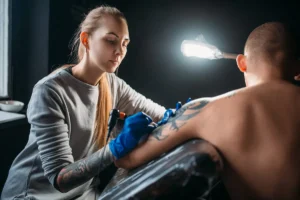
Tattoo artist wearing black gloves preparing a sterile workstation for a tattoo session, illustrating bloodborne pathogens safety standards
Ohio operates on a local-authority model. This means that while OAC 3701-9 sets the “minimum” standards, your local health department is the one that walks through your door.
Columbus Public Health: Known for rigorous oversight in the Short North and surrounding Dublin/Westerville areas, they require documented proof of training for all new and renewing artists.
Cuyahoga County Board of Health: If you’re tattooing in Cleveland, Parma, or Lakewood, CCBH inspectors check that every artist has a BBP certificate that explicitly covers OSHA 29 CFR 1910.1030 standards.
Hamilton County & Cincinnati: Local inspectors here focus heavily on record-keeping, including how long you maintain client consent forms and your proof of training.
The “Single-Use” Rule: Why Your Prep Matters
OAC 3701-9-04 is very specific about “Aseptic Technique.” One of the most scrutinized areas during a 2026 health inspection is skin preparation.
Single-use disposable razors are a non-negotiable requirement. According to Ohio law, any instrument or object applied to a customer’s skin must be single-use and discarded immediately after use. Reusing a razor—even if it seems clean—is a direct violation that can result in an immediate “unsatisfactory” inspection rating for the studio. At ACE, our training reinforces these specific Ohio mandates, ensuring you know exactly how to handle sharps and biohazardous waste disposal.
Sterilization and Record Keeping in 2026
Ohio health inspectors have shifted their focus toward Infection Prevention and Control Plans (IPCP). Every studio must have one, and every artist must be trained on it annually. Your BBP certification is the backbone of this plan. It proves that you understand:
Standard Precautions: Treating every client as if they carry a bloodborne disease like Hepatitis B or HIV.
Aseptic Technique: Maintaining a sterile field from the moment you open your needles to the final bandage.
Aftercare Mandates: Ohio law requires you to provide both verbal and written aftercare instructions to every patron before they leave the chair.
Why ACE is the #1 Alternative to the American Red Cross
Many Ohio artists default to the American Red Cross because they recognize the name, but they often pay $35 or more for a course that isn’t specific to tattooing.
ACE Bloodborne Pathogens Training offers the exact same OSHA-compliant certification for a fraction of the price.
Accepted Statewide: Our certificates are recognized by health boards in Lucas, Montgomery, and Summit counties.
Industry Specific: We don’t talk about hospital settings; we talk about tattoo machines, ink caps, and needle bars.
The $8.00 Price Point: We believe safety should be affordable. Use coupon code ace20 at checkout to drop your price to just $8.00.
Ohio Compliance FAQ
How often do I need to renew my BBP in Ohio? Annual renewal is required under both OSHA federal law and Ohio state administrative code.
Can I take this course on my phone? Yes! Our 2026 platform is fully mobile-optimized, allowing you to finish your training between sessions at the shop.
Is First Aid also required? Yes, Ohio establishments generally require both BBP and First Aid. While this course covers BBP, you should also maintain a current First Aid card.
Setting the Bar High for Infection Control
At the heart of bloodborne pathogen training lies a strong emphasis on infection control, a critical component in maintaining exemplary cleanliness standards within tattoo studios. The training covers vital topics such as hand hygiene, meticulous tool sterilization, and the safe disposal of materials, all of which ensure optimal hygiene throughout the tattooing process. These rigorous practices significantly enhance client satisfaction by fostering an environment of trust and safety. Additionally, adhering to high infection control standards bolsters the artist’s reputation, further contributing to their success and standing within the competitive tattoo industry. By continuously setting the bar high for infection control, artists reaffirm their commitment to quality and client well-being, positioning themselves as leaders in the field.
Ready to get started? Visit ACE Bloodborne Pathogen Training or ACE Training Platforms today and take the next step in your career!
Igniting Creativity – Inspiration Sources for Tattoo Artists
The Vital Importance of OSHA Bloodborne Pathogens Training for Tattoo Artists
Texas Bloodborne Pathogens Training
Tennessee Bloodborne Pathogens Training
California Bloodborne Pathogens Training
Ohio Bloodborne Pathogens Training
Pennsylvania Bloodborne Pathogens Training
New York Bloodborne Pathogens Training
Illinois Bloodborne Pathogens Training
Click here to learn more
ACE Training PlatformsACE Continuing Education CreditsACE Food HandlerACE Home Mortgage